
Press Release
Herausgeber: Internationales Wirtschaftsforum Regenerative Energien (IWR)
Energy Policy: Reiche's Approach Will Lead to Higher Electricity Prices for Industry and Consumers
- Capacity market, EEG amendment and grid connection package shift control of the power system away from the competitive market toward grid operators and state-organized capacity mechanisms
 © H&C / Adobe Stock' />
Energy Policy: Reiche's Approach Will Lead to Higher Electricity Prices for Industry and Consumers
© H&C / Adobe StockMünster (renewablepress) - Federal Economics Minister Katherina Reiche promises supply security, predictability and cost efficiency with her energy policy, guided by the principle of "more market and less permanent subsidy." An analysis by Internationales Wirtschaftsforum Regenerative Energien (IWR) reaches a different conclusion: the planned realignment of energy policy will ultimately lead not to lower but to higher electricity costs for industry and consumers.
Control over the System: How Katherina Reiche Is Realigning Germany's Power System Portfolio
The capacity market, the EEG amendment and the grid connection package intervene in the power system at very different points, but their combined effect is what matters. As a result, Reiche is shifting control of the German power system away from the competitive electricity market toward regulated monopoly companies and state-organized capacity mechanisms. The changed distribution of risk between technologies is a consequence of this realignment.
Grid operators are regulated monopolies and are not subject to conventional competition. According to a recent BNE analysis, the 18 largest distribution grid operators achieved a market-share-weighted average return on equity of 30.1 percent in 2024 under German commercial law (HGB). Going forward, they will have greater influence over which plants connect to the grid, when, and under what conditions. Operators of secured capacity will receive compensation for making capacity available through the state-organized capacity market, in addition to possible electricity market revenues. Renewable energy, by contrast, is to be exposed more strongly to the market, with its expansion tied more closely to available grid capacity.
"This is not forward-looking energy policy, but rather a shift in control of the energy transition toward actors and revenue models that are considerably less exposed to the cost pressure of a competitive electricity market – with far-reaching consequences," said Dr. Norbert Allnoch, CEO of IWR.
Specifically, operators of secured power plant capacity are to receive additional compensation through the capacity market for maintaining that capacity. For new wind turbines, by contrast, the grid connection package is intended to shift more of the risk of grid bottlenecks onto operators: the planned redispatch reservation would allow grid connection in exchange for forgoing financial compensation for subsequent curtailment. Further changes concern the wind energy reference yield model and stricter limits on PV feed-in capacity.
Under the plans, new small rooftop PV systems would no longer receive the EEG minimum remuneration and would have to market their solar power themselves. This would raise barriers to market entry and electricity marketing particularly for private operators, which, in IWR's assessment, favors a stronger concentration among traditional market players. Battery storage systems would continue to be burdened with construction cost contributions for grid connection.
Why More Gas-Fired Power Plants Push Electricity Prices Up, Not Down
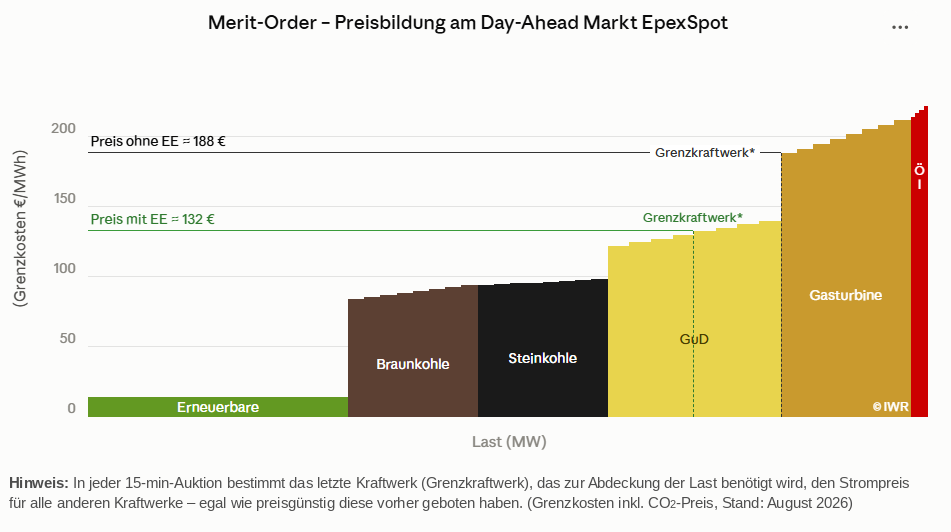
A common public misconception holds that more gas-fired power plants would increase supply and lower prices. The opposite is true. The power exchange operates on the merit-order principle: power plants are ranked according to their bids. The last plant still accepted in the auction sets the price for all other plants, regardless of how low their own bids were.
More renewables displace more expensive power plants from the market, lowering the price for everyone. If renewable expansion is slowed, gas-fired power plants more often remain the price-setting marginal plant – along with the gas price, which is currently high: the European gas price (TTF) stood at around EUR 62.50 per megawatt-hour (6.25 cents/kWh) in mid-August 2026. For a gas-fired power plant with 50 percent efficiency, gas costs alone for generating one kWh of electricity amount to 12.5 cents.
This effect is compounded by the parallel coal phase-out: if electricity from lignite and hard coal plants is replaced by more expensive gas-fired generation instead of renewables and storage, marginal costs rise. If gas-fired power plants consequently become the price-setting plant more often, this leads to higher exchange electricity prices.
From IWR's perspective, this represents a central contradiction in current energy policy: slowing the expansion of renewable energy at the same time undermines precisely the price-lowering displacement effect of wind and solar power. Storage can extend the price-lowering effect into periods of higher demand by shifting cheap electricity from hours of high renewable generation to hours of higher demand, thereby reducing the use of expensive gas-fired power plants.
"None of the planned new regulations from the grid package and the EEG amendment will result in lower electricity prices for industry and consumers – quite the opposite," said Allnoch.
IWR also considers the unspecific expectation of a return to permanently low gas prices to be of little help – more wishful thinking than a viable energy policy perspective. "Some dream of cheap Russian gas once the war in Ukraine ends. But even China, despite its close partnership with Russia, has negotiated hard over prices and terms for additional gas supplies for years. The hope that Germany could simply return to pre-2022 gas prices is no solid basis for the long-term direction of our power system," said Allnoch.
New Capacity Market Levy Instead of Short-Term Electricity Price Relief
In addition to its impact on the exchange electricity price, the capacity market will create additional costs. Under current plans, its financing is to be covered by a new levy starting in 2031. The Federal Ministry for Economic Affairs and Energy estimates costs of EUR 1 billion to EUR 3 billion for capacity support in 2031, to be borne by electricity consumers.
Reiche herself is not promising any short-term reduction in electricity prices. "We will not see noticeable relief until the 2030s," Federal Economics Minister Reiche said in early August.
IWR: Align the Power System Portfolio with Future Viability and Lower Electricity Prices
In IWR's view, energy policy should align the power system portfolio according to which combination of renewable generation, storage, grids, flexible demand and secured capacity delivers supply security at the lowest possible electricity prices. IWR sees the combination of renewable energy and storage as the standard for major tenders as a way to develop the power system for the future.
Grid infrastructure is also changing. Under current plans, the central north-south power links Ultranet, A-Nord, SuedLink and SuedOstLink are to be completed over the next two years, by 2028. They will soon improve the ability to transport electricity between renewable generation hubs in the north and consumption centers in the west and south, helping to reduce grid bottlenecks and the need for redispatch.
Allnoch: "It is the task of policy to actively align the power system portfolio with future viability – much like responsible portfolio management that weighs different opportunities and risks against one another. This includes robust grids and secured capacity as well as renewables, storage and flexible consumers. What matters is not only where investment is directed, but also who controls the system – and what electricity prices that entails for industry and consumers."
Download press graphics:
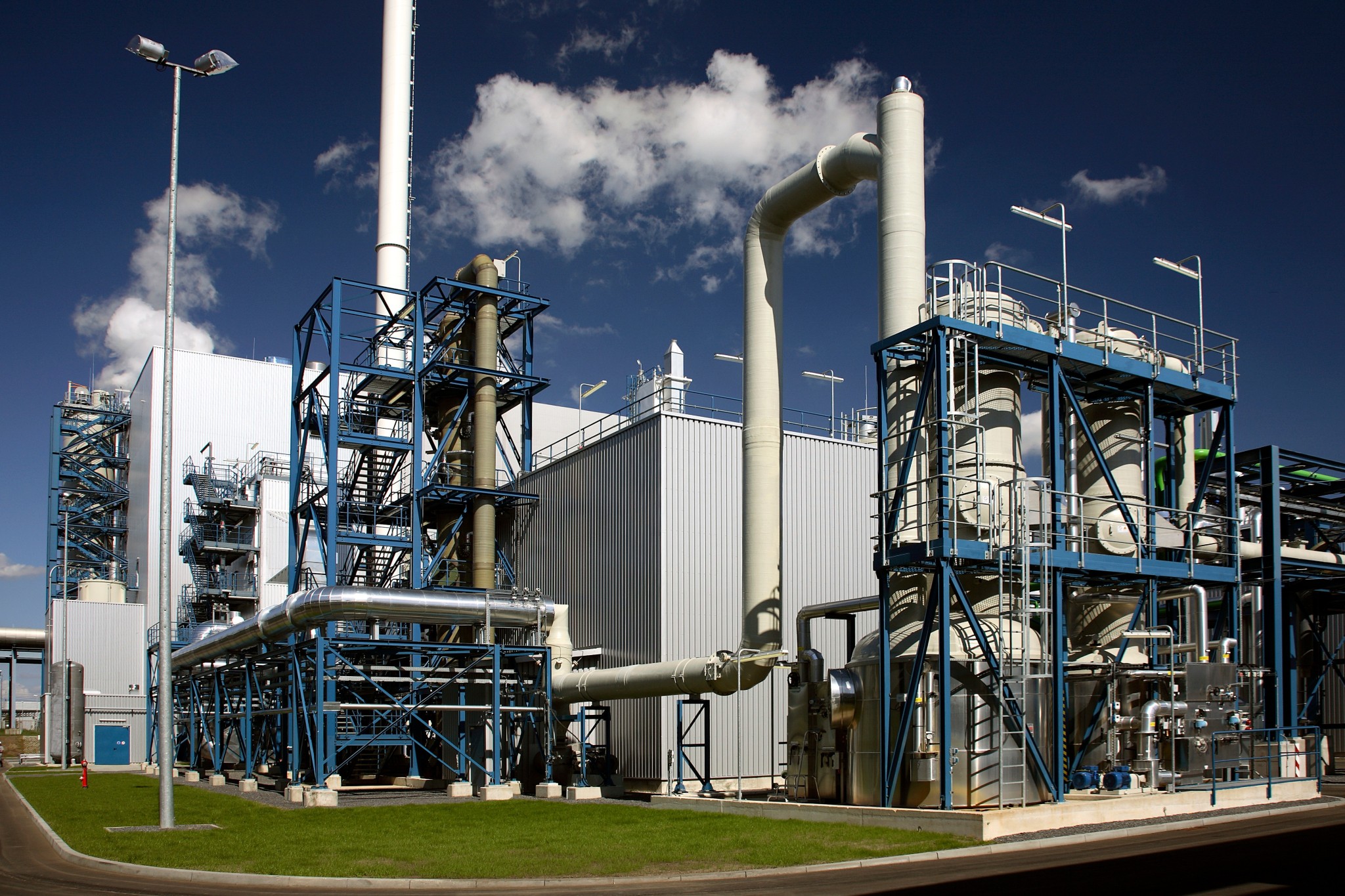
https://www.iwrpressedienst.de/bild/iwr/57c47_IWR-Gaskraftwerk_AS_363536362-2.jpgCaption: Energy Policy: Reiche's Approach Will Lead to Higher Electricity Prices for Industry and Consumers
© H&C / Adobe Stock
 https://www.iwrpressedienst.de/bild/iwr/57c47_IWR_Grafik_Merit_Order_Stand_2026.png
Caption: Electricity Price Formation on the Exchange: Schematic Illustration of the Merit-Order Principle
© IWR
Münster, 21 August 2026
Publication and Reprint free of charge; please send a voucher copy to Internationales Wirtschaftsforum Regenerative Energien (IWR).
Attention editorial offices - For further questions please contact:
Media contact:
Internationales Wirtschaftsforum Regenerative Energien (IWR)
Dr. Norbert Allnoch
Phone: +49 (0)251 / 23 946–0
Fax: +49 (0)251 / 23 946-10
E-Mail: info@iwr-institut.de
Internationales Wirtschaftsforum Regenerative Energien (IWR)
Soester Str. 13
48155 Münster
Germany
Internet: https://www.iwr-institute.com
Sprache:


Online-Pressemappe - alle Pressemitteilungen der Internationales Wirtschaftsforum Regenerative Energien (IWR) | RSS-Feed abonnieren
 Seite teilen / merken
Pressebilder nur für die redaktionelle Verwendung
KI-Unterstützung Art. 50 KI-Act: keine, gemäß Angabe des Herausgebers
Hinweis: Für den Inhalt der Pressemitteilung ist der Emittent / Herausgeber der Meldung »Internationales Wirtschaftsforum Regenerative Energien (IWR)« verantwortlich.
Die Pressemitteilung "Energy Policy: Reiche's Approach Will Lead to Higher Electricity Prices for Industry and Consumers" von Internationales Wirtschaftsforum Regenerative Energien (IWR) ist auch in folgenden Sprachen abrufbar
-
Energiepolitik: Reiches Kurs bringt Industrie und Verbrauchern höhere Strompreise
-
Política energética: el rumbo de Reiche encarece la electricidad para la industria y los consumidores
-
Politique énergétique : le cap fixé par Reiche entraîne une hausse des prix de l'électricité pour l'industrie et les consommateurs
 Daten werden aktualisiert...Daten werden aktualisiert...
About Internationales Wirtschaftsforum Regenerative Energien (IWR)
In 1996, the International Economic Platform for Renewable Energies (IWR) was established as an independent and private service institution of the renewable energy industry. The IWR focuses on the fields of research, economic and policy consultation as well as media and international networks in the renewable or regenerative energies sector. One main objective of the IWR is to play an instrumental role in introducing and spreading awareness for an industrial, international business profile of the renewable energy industry.
Dr. Norbert Allnoch, Director of the International Economic Platform of Renewable Energies (IWR), 1995, on the definition: "According to our definition, the Renewable Energy Industry is one which takes an interdisciplinary approach to the issue of renewable energy supply (protecting both the climate and resources) and the construction of renewable plants and systems (industry policy for the three areas electricity, heat and fuel."Chronology of the Renewable Energy Industry - Important IWR contributions, including prizes and awards - 2007 Publication of the first structural analysis for a federal state according to the IWR-analysis method for renewable systems engineering and services�(study "Zur Lage der regenerativen Energiewirtschaft in NRW" )2007 International network-contacts:IWR-director Dr. Allnoch speaks with King Harald V. of Norway and �slaug Haga, norwegian minister of energy Presentation of the network / RENIXX in the USA, dialogue with McGinty, environment minister of Pennsylvania2006 IWR starts renewable stock index RENIXX� (
Business areas
- Research, economic and policy consultation
- National and international networks
- Media-services
Products & Services
- Market studies, reports, energy scenarios
- International network "Renewable Energy Industry":
Economics, R&D, institutes & universities, countries, regions & municipals - Media services:
Press services � Sending original press releases, energy job exchange, company and product marketing, marketing for commercial sites - Global stock index for renewable�energies RENIXX�
- Wind farm yield check
- Biodiesel / bioethanol�price index
- Business climate index of the renewable energy industry