
Press Release
Herausgeber: Internationales Wirtschaftsforum Regenerative Energien (IWR)
Oil and Gas Prices: Renewables and Storage Offer the Best Protection Against Price Shocks and Inflation
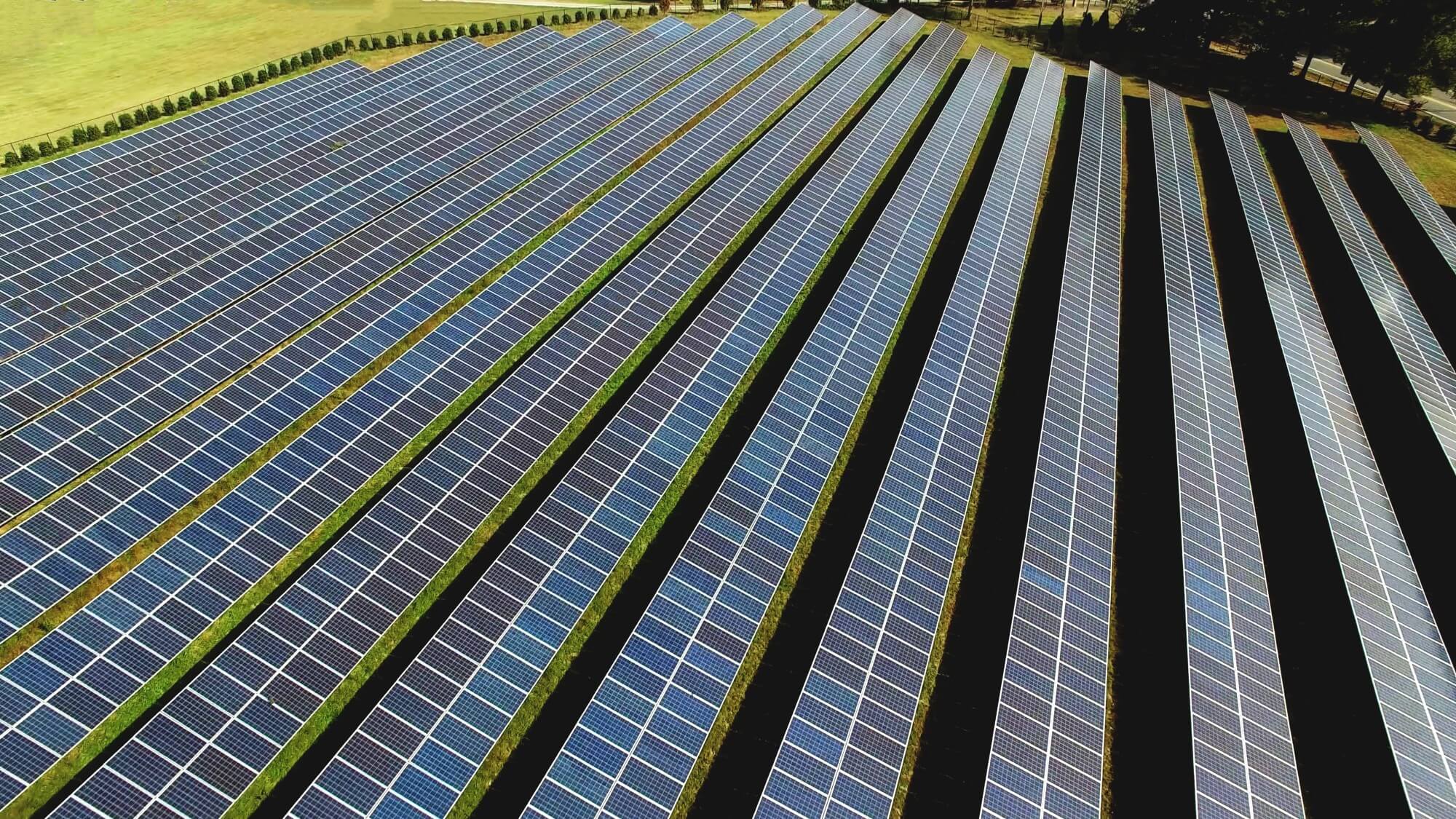
Oil and gas prices: renewables and storage offer the best protection against price shocks and inflation
© WADII / Adobe StockMünster (renewablepress) - A renewed price shock in the oil and gas markets is adding to global inflationary pressure and putting Germany's dependence on fossil fuel imports back in focus. On September 10, 2026, the European Central Bank (ECB) raised its key interest rates by 0.25 percentage points, explicitly citing persistent inflationary pressure linked to the conflict in the Middle East.
Oil and gas prices are set on international markets, and Germany cannot shield itself from that price risk simply by switching suppliers or delivery routes. Domestic renewable energy reduces this dependence and acts as a brake on prices. "The drivers of these price increases have a name: fossil fuels. The best protection against inflation is the transformation from oil and gas to electricity generated from domestic renewable energy, combined with energy storage," said Dr. Norbert Allnoch, CEO of Internationales Wirtschaftsforum Regenerative Energien (IWR).
Lower Electricity Prices: How Solar Power Is Already Squeezing Costly Gas-Fired Plants Out of Price Formation
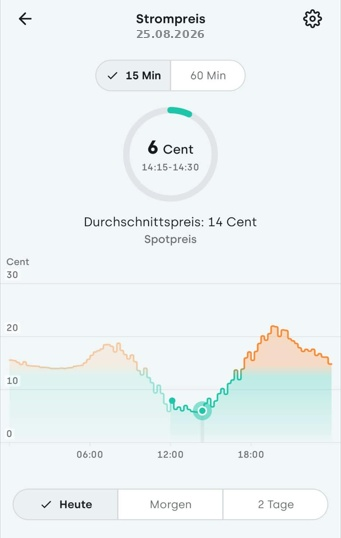
The decoupling from expensive fossil energy in the power market is already visible. On days with particularly high sunshine levels, exchange electricity prices typically fall sharply over the course of the day as solar generation rises toward midday, then climb again in the evening as PV output declines.
This pattern is often described in public debate through a misleading chain of causation: too much solar power allegedly floods the grid at midday, creating an "oversupply" that is worthless, overloads the power grid, and has to be "dumped" abroad at low prices. This portrayal conflates price formation on the electricity exchange with the physical and grid-technical processes of the electricity system.
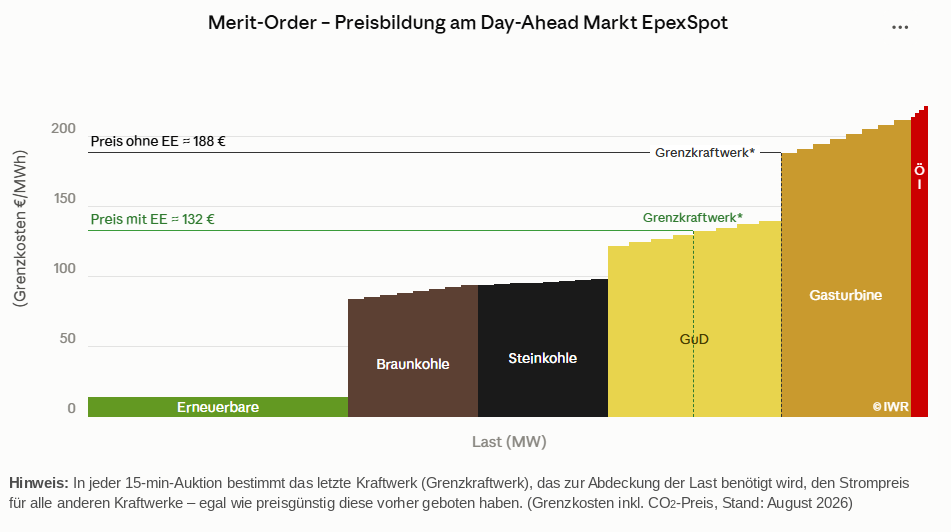
In reality, exchange electricity prices are set according to the merit order principle, or marginal cost model. Power plants are ranked by their bids, and the last plant needed to cover demand sets the price for all plants accepted in the auction - regardless of how low their own bid was. Solar installations offer power at low marginal cost, pushing plants with higher marginal costs, such as gas-fired plants, further down the merit order. As a result, exchange electricity prices fall. The low midday price is therefore a market price signal, not evidence of grid overload.
The principle is illustrated clearly by current high gas prices. At a current gas price of around EUR 80 per MWh at the benchmark European TTF hub, a gas-fired power plant with an assumed electrical efficiency of 50 percent incurs fuel costs alone of roughly EUR 160 per MWh of electricity, or 16 euro cents per kWh - before CO2 costs and other variable costs are added. If such a plant is not needed to cover demand and is instead pushed out of the merit order by cheaper generation, it can no longer set the high exchange electricity price. A cheaper plant, or bid, determines the price instead. The more renewables push expensive plants down the merit order, the further exchange electricity prices fall.
Exchange Electricity Prices and Grid Congestion Are Two Different Things
Independent of price formation on the electricity exchange, regional grid bottlenecks and curtailment of renewable installations do occur. Even so, more than 96 percent of the renewable electricity generated in 2025 was fed into the grid and delivered to end consumers, according to the Bundesnetzagentur (Federal Network Agency). A low or negative exchange electricity price is therefore not automatically an indicator of grid congestion.
Transport capacity between renewable generation centers and consumption centers will continue to expand with the commissioning of the major north-south power links Ultranet (2,000 MW), A-Nord (2,000 MW), SuedLink (4,000 MW), and SuedOstLink (2,000 MW) by 2028.
Battery Storage Shifts Cheap Power into Expensive Hours
It is precisely the low midday electricity prices that create the economic incentive for battery storage. Batteries buy power when prices are low, store it, and sell it again during the more expensive morning and evening hours - shifting power volumes across the day in line with market price signals.
The effect works on prices in both directions: charging increases demand during the cheap midday hours, while discharging increases supply during the more expensive morning and evening hours. This pushes exchange electricity prices down at those times too and moves expensive gas-fired plants further down the merit order.
The combination of renewables and battery storage therefore extends the price-dampening effect of wind and solar power across the day. The more cheap renewable electricity can be shifted in time, the less often expensive gas-fired plants are left to set the price - and the smaller the influence of high international gas prices on German exchange electricity prices.
IWR Criticizes Federal Government: State-Subsidized Fossil Gas Plants Send the Wrong Price Signal
Against this backdrop, IWR takes a critical view of the way the German federal government has currently designed its strategy. State-subsidized gas-fired plants on the planned scale - which are not held purely in reserve but can also participate in the electricity market - represent an additional electricity price risk when gas prices are high. If such plants are needed for power generation, their high fuel costs can feed directly into the exchange electricity price via the merit order.
"A permanently competitive level of electricity prices is of central importance for the German economy. That goal conflicts with a federal government electricity market design in which expensive fossil plants frequently set the exchange electricity price. What matters is that the fossil price risk of these plants comes into effect as rarely as possible," said Allnoch.
To strengthen Germany as a business location, the focus should therefore be on further expansion of wind and solar energy combined with privately operated battery storage. Domestic renewable energy reduces dependence on fossil fuels, whose prices are set on international markets and are therefore subject to price risks that cannot be controlled at the national level. Storage shifts cheap power volumes into the more expensive hours, helping ensure that expensive gas-fired plants set the exchange electricity price less often.
Download press graphics:
https://www.iwrpressedienst.de/bild/iwr/a2e51_Solarpark_AS_ewL_452168494.jpg
Caption: Oil and gas prices: renewables and storage offer the best protection against price shocks and inflation
© WADII / Adobe Stock
 https://www.iwrpressedienst.de/bild/iwr/a2e51_Strompreise-Tibber-250826.png
Caption: Exchange electricity prices over the course of the day on August 25, 2026
© Tibber
 https://www.iwrpressedienst.de/bild/iwr/a2e51_IWR_Grafik_Merit_Order_Stand_2026.png
Caption: Price formation on the electricity exchange: schematic representation of the merit order principle
© IWR
Münster, 14 September 2026
Publication and Reprint free of charge; please send a voucher copy to Internationales Wirtschaftsforum Regenerative Energien (IWR).
Attention editorial offices - For further questions please contact:
Media contact:
Internationales Wirtschaftsforum Regenerative Energien (IWR)
Dr. Norbert Allnoch
Phone: +49 (0)251 / 23 946–0
Fax: +49 (0)251 / 23 946-10
E-Mail: info@iwr-institut.de
Internationales Wirtschaftsforum Regenerative Energien (IWR)
Soester Str. 13
48155 Münster
Germany
Internet: https://www.iwr-institute.com
Sprache:


Online-Pressemappe - alle Pressemitteilungen der Internationales Wirtschaftsforum Regenerative Energien (IWR) | RSS-Feed abonnieren
 Seite teilen / merken
Pressebilder nur für die redaktionelle Verwendung
Hinweis: Für den Inhalt der Pressemitteilung ist der Emittent / Herausgeber der Meldung »Internationales Wirtschaftsforum Regenerative Energien (IWR)« verantwortlich.
Die Pressemitteilung "Oil and Gas Prices: Renewables and Storage Offer the Best Protection Against Price Shocks and Inflation" von Internationales Wirtschaftsforum Regenerative Energien (IWR) ist auch in folgenden Sprachen abrufbar
 Daten werden aktualisiert...Daten werden aktualisiert...
About Internationales Wirtschaftsforum Regenerative Energien (IWR)
In 1996, the International Economic Platform for Renewable Energies (IWR) was established as an independent and private service institution of the renewable energy industry. The IWR focuses on the fields of research, economic and policy consultation as well as media and international networks in the renewable or regenerative energies sector. One main objective of the IWR is to play an instrumental role in introducing and spreading awareness for an industrial, international business profile of the renewable energy industry.
Dr. Norbert Allnoch, Director of the International Economic Platform of Renewable Energies (IWR), 1995, on the definition: "According to our definition, the Renewable Energy Industry is one which takes an interdisciplinary approach to the issue of renewable energy supply (protecting both the climate and resources) and the construction of renewable plants and systems (industry policy for the three areas electricity, heat and fuel."Chronology of the Renewable Energy Industry - Important IWR contributions, including prizes and awards - 2007 Publication of the first structural analysis for a federal state according to the IWR-analysis method for renewable systems engineering and services�(study "Zur Lage der regenerativen Energiewirtschaft in NRW" )2007 International network-contacts:IWR-director Dr. Allnoch speaks with King Harald V. of Norway and �slaug Haga, norwegian minister of energy Presentation of the network / RENIXX in the USA, dialogue with McGinty, environment minister of Pennsylvania2006 IWR starts renewable stock index RENIXX� (
Business areas
- Research, economic and policy consultation
- National and international networks
- Media-services
Products & Services
- Market studies, reports, energy scenarios
- International network "Renewable Energy Industry":
Economics, R&D, institutes & universities, countries, regions & municipals - Media services:
Press services � Sending original press releases, energy job exchange, company and product marketing, marketing for commercial sites - Global stock index for renewable�energies RENIXX�
- Wind farm yield check
- Biodiesel / bioethanol�price index
- Business climate index of the renewable energy industry